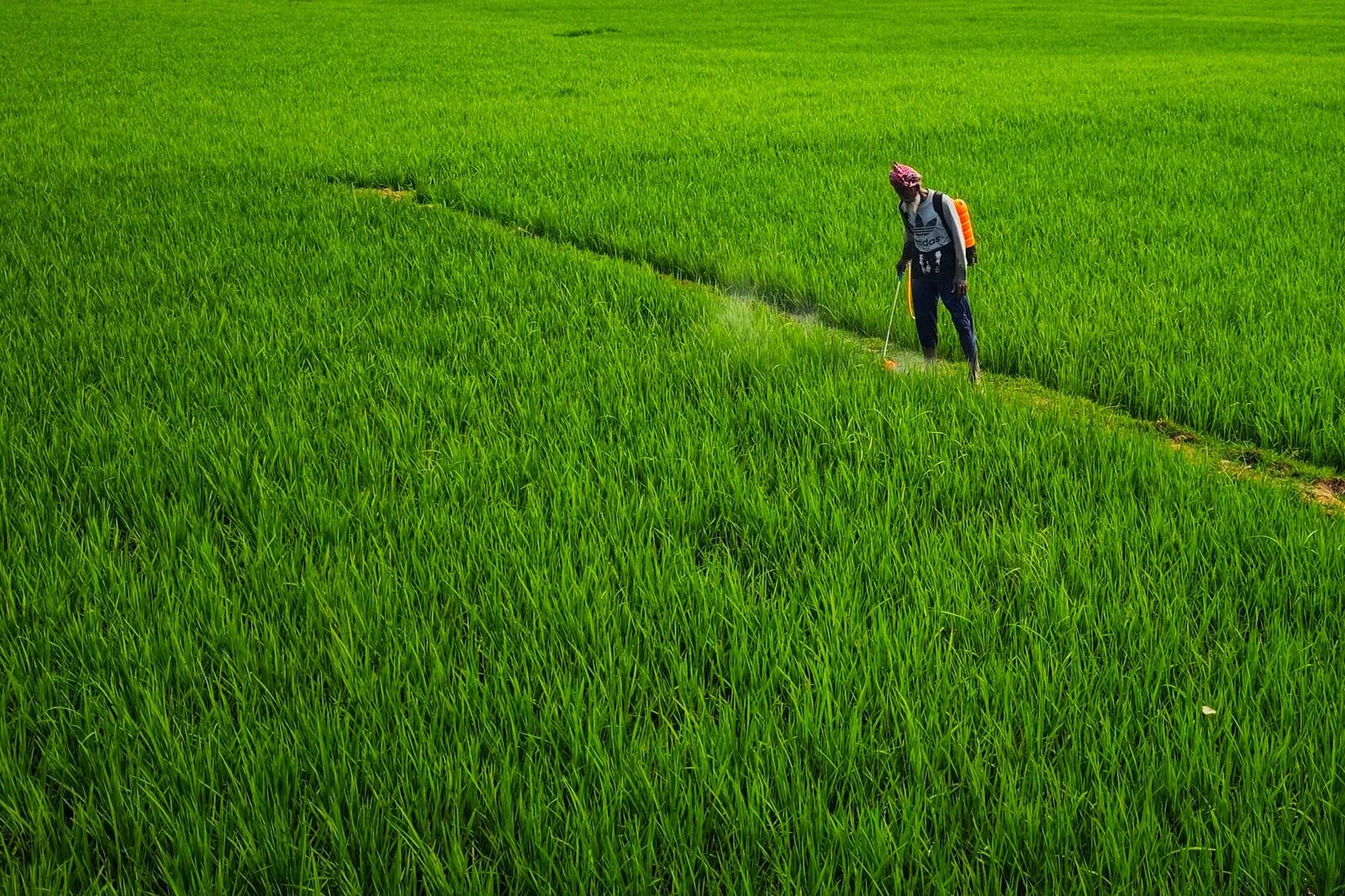
Glyphosate is the most widely used herbicide in American agriculture, and the active ingredient in Roundup. It kills nearly any green plant it touches, which is exactly why it became the default tool on corn, soybean and cotton ground, and why it is now so hard for farmers to walk away from.
What is glyphosate?
Glyphosate is a broad-spectrum, systemic herbicide. Monsanto brought it to market in 1974 as Roundup, and the patent expired in 2000, so dozens of generic products now carry the same active ingredient. It is absorbed through leaves and moves through the plant down to the roots.
How does glyphosate kill weeds?
It blocks an enzyme called EPSP synthase, which plants and some microbes use to build certain amino acids. Without those amino acids the plant stops growing and dies, usually within one to three weeks. Animals do not have this pathway, which is the core of the industry argument that glyphosate is low in acute toxicity. Critics respond that acute toxicity is not the same question as long-term, low-dose exposure, and that gut and soil microbes do use the pathway.
What is glyphosate used for?
- Burndown before planting. Clearing a field of weeds so no-till planting can happen without plowing.
- In-season spraying on Roundup Ready crops. Genetically engineered corn, soybeans, cotton and canola tolerate glyphosate, so farmers can spray the whole field and kill only the weeds. Roundup Ready soybeans arrived in 1996.
- Pre-harvest use on some crops. Some growers of small grains and other crops apply it near harvest to dry down fields.
- Non-farm uses. Lawns, roadsides, utility corridors and forestry.
Why can’t farmers quit it?
Three things stack up.
- Cost and labor. One cheap pass replaced multiple herbicides and a lot of cultivation. An Illinois analysis put the cost of losing it at $300 million to $609 million a year for that state’s growers.
- Seed lock-in. The traits are sold with the seed. Our reporting on seed and input consolidation shows how a few companies sell the seed, the trait and the chemical.
- No quick replacement. Switching means more tillage, more passes, more labor, or a shift to cover crops and diverse rotations that take years and money to set up.
The resistance problem
Heavy reliance on one chemical selects for weeds that survive it. Glyphosate-resistant waterhemp and Palmer amaranth are now serious problems in Midwestern and Southern fields, and the Weed Science Society of America tracks glyphosate resistance in dozens of species worldwide. Farmers respond by adding other herbicides, including older and more drift-prone ones, which raises costs and can bring new health and neighbor disputes. See our coverage of the paraquat fight for what that looks like in practice.
Does glyphosate cause cancer?
The agencies disagree, and that disagreement is the center of the fight.
- IARC, the World Health Organization’s cancer research arm, classified glyphosate as “probably carcinogenic to humans” (Group 2A) in 2015, citing limited evidence in humans for non-Hodgkin lymphoma and stronger evidence in animals.
- The EPA has repeatedly concluded that glyphosate is not likely to be carcinogenic to humans at approved uses. A federal appeals court in 2022 sent part of the EPA’s human health analysis back for more work, so the review has not been settled.
- Bayer, which bought Monsanto in 2018, maintains that the product is safe when used as directed.
Group 2A is a hazard rating, not a measure of how likely any one person is to get sick. Real-world risk depends on dose and exposure, which is why farmworkers and applicators are the people most often at the center of the research and the lawsuits.
The courtroom fight
Thousands of plaintiffs have sued over Roundup and cancer. In June 2026 the Supreme Court ruled that federal pesticide law preempts state failure-to-warn claims, as we covered in Supreme Court blocks Roundup cancer suits. That pushes the question back to regulators. In September, HHS and the EPA announced joint research on glyphosate safety, which we explain in What Is Glyphosate, and Why It Matters.
What are the alternatives?
None is a drop-in swap, and each has tradeoffs.
- Cover crops and diverse rotations suppress weeds and build soil, but they need seed money, management skill and time.
- Reduced or targeted tillage and cultivation cut herbicide use but cost fuel and labor and can raise erosion risk.
- Other herbicides work but carry their own resistance and toxicity problems.
- Precision spraying uses cameras to spot-treat weeds and cuts volume, though the equipment is expensive for small farms.
The honest bottom line: glyphosate is cheap, effective and entrenched, and the case against it rests on contested health evidence and a growing resistance problem. Farmers who want out need transition funding, not just a ban.
FAQ
What is glyphosate in simple terms? A weed killer that kills most plants by blocking an enzyme they need to grow. It is the active ingredient in Roundup.
Is glyphosate banned anywhere? Some countries and localities have restricted it. In the US there is no federal ban.
Who makes it? Bayer (through Monsanto) still sells Roundup, and many companies sell generic glyphosate.


